
Diaphragm Adhesion in Current Diaphragm Pumps: A Common Challenge and Mitigation Strategies
Membrane adhesion in diaphragm pumps is a common issue across various brands and remains a persistent challenge that many pump manufacturers strive to overcome. Currently, there is no definitive solution to completely eliminate this problem; improvements are limited to mitigation with varying degrees of success. Except for PTFE plastic, adhesion remains a potential risk regardless of the treatment applied.
Diagram of Diaphragm Pump Internal Structure:
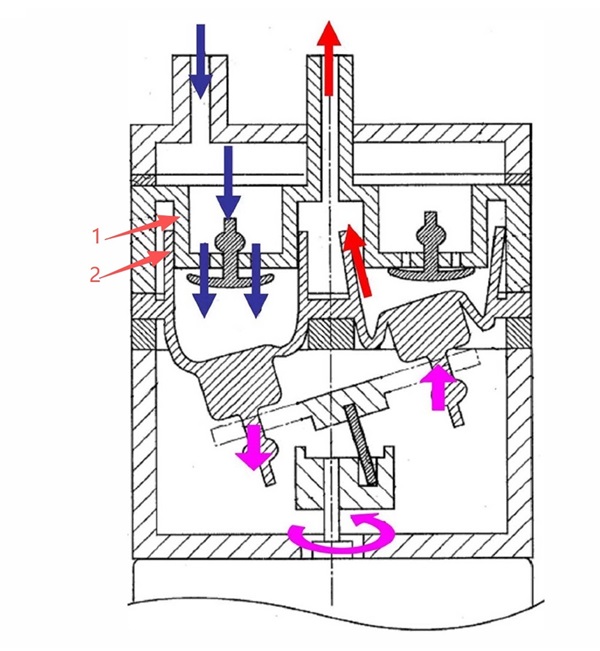
Cause of Adhesion:
As shown in the diagram above, adhesion primarily occurs at the interface between parts 1 and 2. When the pump is dry, the gap between parts 1 and 2 is usually sufficient to prevent adhesion. However, after pumping water, moisture causes parts 1 and 2 to adhere. As the water evaporates, the bond strengthens, eventually leading to pump failure.
Characteristics of Adhesion:
- Adhesion typically occurs within 1 to 6 months. It happens faster in summer due to rapid evaporation and slower in winter.
- If adhesion is recent, the motor's force might tear the diaphragm loose, allowing the pump to resume operation temporarily.
- Whether through surface treatments or material changes, adhesion may still occur—only the timeframe and bond strength differ.
- This issue only happens after the pump has been used with water and then left idle for an extended period. Regular use, or even a single use per month, prevents adhesion.
- The type of water (distilled, tap, mineral, nutrient-rich) does not prevent adhesion; it can occur with any.
NIDEC's Attempts to Address Adhesion:
- Increasing the cam diameter on the motor shaft and lengthening the connecting rod to enhance tearing force. This improved the chance of separation after adhesion but reduced pump lifespan due to excessive diaphragm deformation.
- Applying surface treatment to the rubber (Part 2). This altered the rubber's properties and negatively affected diaphragm longevity.
- Reducing the contact area between Parts 1 and 2. This was abandoned as it caused flow instability.
- Finalized Solution: Without altering the flow path or other characteristics, NIDEC applied fluorination treatment to Part 1, drawing on experience from DVD motor waterproofing. This lowers the SPS surface energy, reducing plastic-rubber adhesion.
Industry Practices for Managing Diaphragm Pump Adhesion:
- Priming/Emptying Method: NIDEC uses a 30-second emptying procedure during final inspection. However, users found residual moisture can still cause adhesion. NIDEC's success is attributed to desiccants in the packaging that rapidly absorb moisture. Some manufacturers extend the emptying time to over 3 minutes.
- Water-Retention Method: Most medical device manufacturers keep water in the pump to prevent adhesion. Methods include: Adding a valve in the pipeline to retain water between the valve and the pump. Using a rubber sleeve at the inlet/outlet to prevent drying before customer receipt. Removal after delivery is fine as regular use then prevents adhesion. Creating a U-bend in the tubing to intentionally trap a small amount of water during testing. Slow evaporation allows this to last over six months.
- Material/Coating Changes: FKM (Viton) pumps significantly reduce adhesion probability but are rarely used due to high cost. NIDEC's model 00H220H012-1, with its fluorination treatment, reduces adhesion likelihood and delays its onset. It is often combined with priming or water-retention methods for minimal risk.
Summary: The water-retention method effectively prevents adhesion. However, practical constraints often prevent its use, leading many manufacturers to combine methods (e.g., using the 00H220H012-1 pump with priming). Customer feedback confirms the effectiveness of these combined approaches.
Interim Countermeasures:
- For products already with customers: Replace with a new or non-adhered 00H220H012 pump. Regular use post-replacement prevents recurrence. (For an already adhered pump, gently injecting water into the inlet with a syringe can release the diaphragm, restoring function.)
- For inventory not yet shipped: Re-inspect and leave a portion of distilled or pure water in the tubing. Evaporation is very slow (several months), preventing adhesion before customer receipt.
Permanent Countermeasure:
Switch to the NIDEC 00H220H012-1 pump, specifically customized for ultrasonic scalers. This reduces adhesion probability and delays its onset. However, for complete prevention, it must be combined with either the water-retention or extended priming method.