

Water-curtain humidifiers (also known as wet-film humidifiers), compared to ultrasonic humidifiers, heated humidifiers, and centrifugal humidifiers, are distinguished by their core advantages of high efficiency, stability, safety, and ease of maintenance. They are particularly well-suited for humidifying large spaces that demand high air quality. Their main benefits are as follows:
- High Humidification Efficiency, Uniform and Comfortable Output: Water is evenly distributed over the wet-film medium, and as air passes through, it is rapidly humidified via evaporation. This process offers fast humidification speed. The output air reaches humidity saturation, preventing localized over-humidification or water droplet formation, resulting in a naturally comfortable feel.
- Low Water Quality Requirement, No "White Dust" Pollution: Operating on the principle of adiabatic (isenthalpic) humidification, the majority of minerals in the water, such as calcium and magnesium ions, are trapped on the wet film or discharged with the drainage water. They are not released into the air as mist, completely avoiding the common "white dust" pollution issue associated with ultrasonic humidifiers. This makes them more friendly to furniture, electrical appliances, and other equipment.
- Safe, Reliable, Energy-Efficient, and Eco-Friendly: The design utilizes no heat source (cold evaporation), eliminating the risk of scalding. Energy consumption is extremely low, with the main power draw coming from the fan and water pump, which is far less than that of heated humidifiers. It provides clean humidification and is less prone to bacterial growth, especially when combined with regular cleaning and water purification functions.
- Suitable for Large Areas and Easy Integration: A single unit can be designed for high humidification capacity, making it commonly used in large offices, data centers, textile mills, printing plants, greenhouses, and other venues requiring large-scale humidity control. It is also easily integrated with HVAC units and fresh air systems.
- Relatively Convenient Maintenance: The core component is the wet film. Performance can be maintained by regularly replacing or cleaning the wet film. Its simple structure has fewer potential points of failure.
In summary: If you need to provide stable, clean, and safe humidification for spaces ranging from tens to thousands of square meters, with a desire for low operating costs and no mineral dust pollution, a water-curtain humidifier is an ideal choice.
The water supply system for a water-curtain humidifier (wet-film humidifier) typically requires stable flow, moderate pressure, reliable operation, and low noise. Depending on the specific design, scale, and cost considerations, two main types of water pumps are primarily used:
Micro Centrifugal Pump (Most Common)
This is the preferred choice for the vast majority of water-curtain humidifiers because it perfectly matches the operational characteristics of wet-film humidification.
- Working Principle: A motor drives an impeller to rotate at high speed, generating centrifugal force to discharge water.
- Why It's the Best Fit: Flow and Pressure Match: Wet-film humidification only requires lifting water to the top water distribution system (usually a head of 1-3 meters is sufficient), after which it relies on gravity to trickle down evenly. Centrifugal pumps provide stable, continuous, and relatively high flow rates at low head, perfectly meeting the requirement for "low pressure, high flow." Smooth Operation: Water discharge is continuous and even, without pulsation, aiding in the formation of a uniform water film on the wet medium. Simple and Durable Structure: Few core components, low failure rate, and easy maintenance. Cost-Effective: Mature technology offers a high price-performance ratio. Relatively Low Noise.
Small Submersible Pump
This type is also used in some simplified designs or specific integration schemes.
- Working Principle: The motor and pump body are integrated and operate completely submerged in the water tank.
- Application Scenarios: Often used in integrated small water-curtain humidifiers or DIY solutions, featuring a compact structure and simple installation. In split-type large systems, a submersible pump may sometimes be placed in the bottom water tank to supply water to the upper unit.
- Points to Note: Long-term submersion places high demands on seals and motor insulation, so its reliability and lifespan require attention.

Nidec (NIDEC) Diaphragm Pumps are favored by water-curtain (wet-film) humidifier manufacturers not only for their excellent product performance but also for the positive role they play in elevating the overall standard of products in the industry. Key advantages include:
- Nidec diaphragm pumps feature a three-chamber design, which solves the problem of flow pulsation, ensuring stable and continuous flow.
- Diaphragm pumps possess strong self-priming capability. Unlike centrifugal pumps, they do not need to be placed below the water tank and can be positioned arbitrarily, providing flexibility in product design.
- Nidec brushless diaphragm pumps offer a wide flow rate adjustment range, capable of delivering from a few milliliters to several hundred milliliters per minute. This allows for arbitrary adjustment of the mist output level.
- They operate with minimal noise (Nidec diaphragm water pumps, operating at full speed without any noise treatment, have a noise level of approximately 35 dB(A). With PWM speed control and appropriate noise treatment, achieving "silent" operation is straightforward).
- They can easily meet the service life requirements of humidifiers. Nidec diaphragm water pumps have a service life exceeding 10,000 hours when operating at a full speed of 5000 rpm. In practical use, the pump's lifespan can be significantly extended by reducing the motor speed (see the speed vs. flow rate chart).
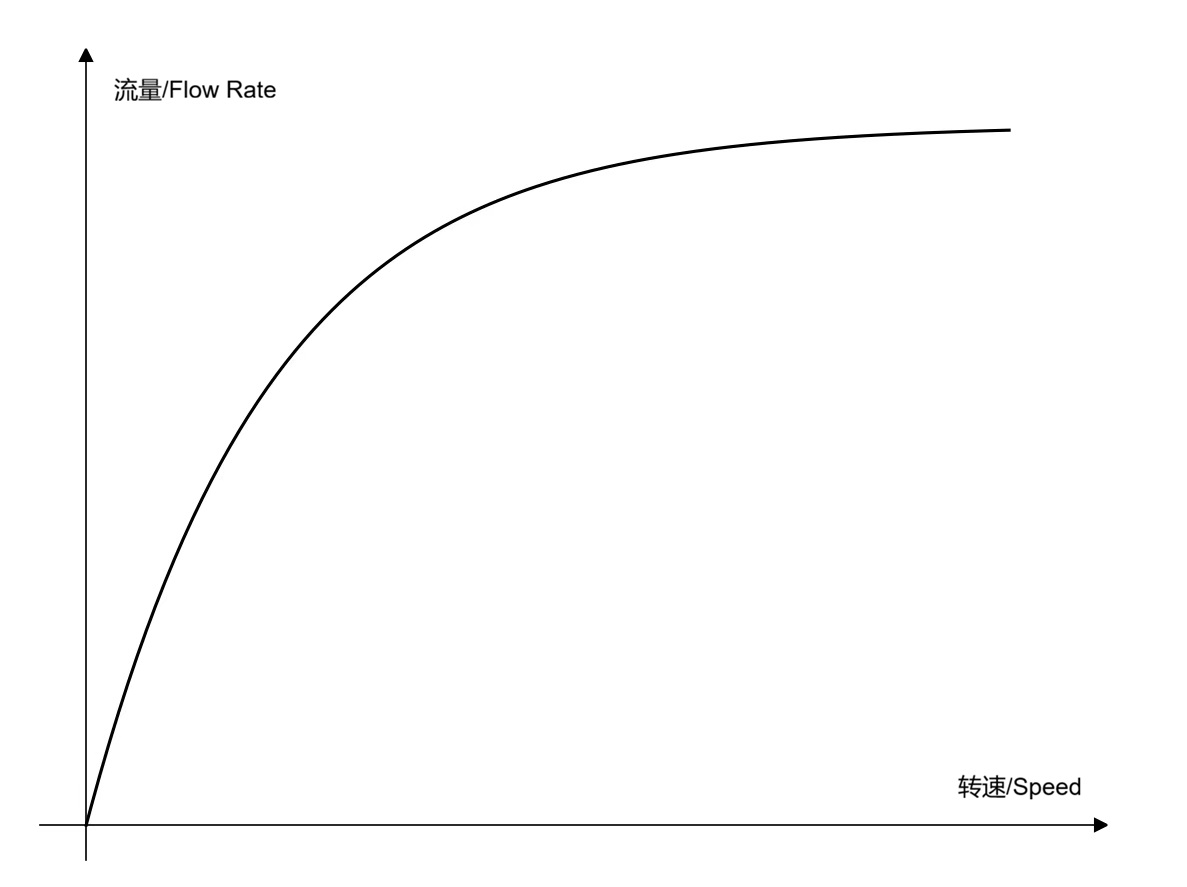
- Diaphragm pumps are compact in size, occupying minimal space, which facilitates flexible product design.