
Direct measurement of brushless DC motor speed without the need for additional circuitry primarily involves the following types of equipment:
- Handheld Non-Contact Tachometers (Most Common and Convenient) Laser/Photoelectric Tachometers: Emit a laser or light beam onto a rotating object (e.g., motor shaft or attached reflective marker) and receive the reflected signal to directly calculate and display the rotational speed (RPM). Features: Ready-to-use, safe distance measurement, suitable for on-site maintenance, temporary measurements, and situations where sensors cannot be installed.
- Contact Digital Tachometers Centrifugal/Contact Tachometers: Equipped with a rubber cone or gear at the tip, which is pressed directly against the center of the motor shaft for measurement through mechanical contact transmission. Features: Requires physical contact, applicable when the shaft end is accessible, but accuracy may be affected by slipping.
- Oscilloscopes Applicable Conditions: Requires the motor to have output signal lines such as FG (Frequency Generator), Hall sensor, or encoder pulse signals. Method: Connect probes to the signal lines, measure the pulse frequency, and calculate the rotational speed. Features: Capable of observing waveform quality, but the equipment is expensive, operation is relatively complex, and it is primarily used for diagnostic analysis.
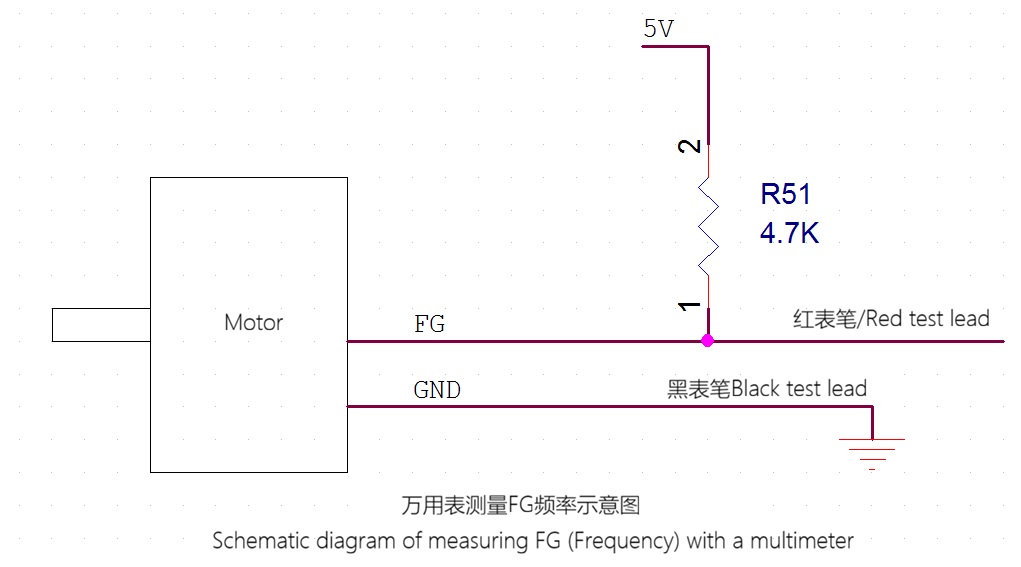
- Multimeters with Frequency Measurement Function Applicable Conditions: Only applicable when the motor has an FG (Frequency Generator) signal output line (common in fans and some brushless DC motors). Method: Set the multimeter to the frequency measurement mode, directly connect the probes to the FG line and ground line, and the screen will display the frequency value (Hz), which can be converted to rotational speed. Features: Economical and convenient, but requires the motor to have an FG signal output interface.
When measuring the rotational speed of a brushless DC diaphragm pump, conventional methods such as non-contact optical tachometry or contact tachometry are not feasible because the motor’s output shaft is internally connected to the pump head, leaving no exposed shaft end for attaching reflective markers. Additionally, oscilloscope-based speed measurement is relatively complex and requires specialized knowledge and skills. In such cases, using a multimeter with frequency measurement capability for speed testing becomes an efficient alternative that combines convenience, cost-effectiveness, and ease of operation.
Below is the wiring diagram for using a multimeter to measure the rotational speed of a diaphragm pump:
Note: NIDEC diaphragm pump models with FG signal output include:
00H704V310, 00H220H012, 00H220H022, 00H220H024, 00H220H032, 00H220H035, 00H220H042, 00H704K610, 00H220H012-1, 00H220L230, 00H220R200