
Brushless DC motors (BLDC) achieve precise control over current, speed, and position through a closed-loop control system, thereby striking an excellent balance between performance and cost. Especially in scenarios where stepper motor performance is insufficient, and the product is sensitive to price and cost, making the procurement of permanent magnet synchronous servo motors unfeasible—such as applications requiring high speed, low vibration, high efficiency with low heat generation; high positioning accuracy; and a wide speed regulation range—brushless DC servo motors should be the ideal choice for motor solutions and are widely used across numerous fields.
The following details the high cost-effectiveness of these motors in terms of both performance and cost:
Performance: Significantly Superior to Steppers, Approaching High-End Servos
- Dynamic Response & Speed Superior to Stepper Motors: Stepper motors suffer from severe torque drop at high speeds and are prone to losing steps. Brushless DC servos, with closed-loop control, maintain rated torque even at high speeds, offering faster response (millisecond level). They are suitable for scenarios involving frequent start-stop operations and high-speed running. Close to Permanent Magnet Synchronous Servos: High-end servo motors (PMSM using sine wave drive) excel in extremely low-speed smoothness and noise control. However, modern brushless DC servos offer dynamic response in common speed ranges that is very close, meeting the vast majority of industrial demands.
- Control Accuracy & Stability Far Superior to Stepper Motors: Stepper motors operate with open-loop control, carrying the risk of lost steps, and their accuracy depends on the step angle. Brushless DC servos achieve precise position, speed, and torque control through encoder-based closed-loop feedback, eliminating cumulative error and offering stronger load capacity. Slightly Inferior to High-End Servos: High-end servos with sine wave drive still hold a theoretical advantage in applications requiring extremely high precision (e.g., nanometer-level positioning) and ultra-low-speed smooth operation.
- Overload Capacity & Efficiency Significantly Superior to Stepper Motors: Stepper motors operate at rated current continuously, leading to easy heating and poor overload capacity. Brushless DC servos output current only when torque is needed, resulting in high efficiency, low heat generation, and typically 2-3 times the instantaneous overload capacity to handle sudden load changes. Comparable Efficiency to Permanent Magnet Synchronous Servos: Both use permanent magnet rotors, offering efficiency far superior to stepper motors and significant energy-saving effects.
Cost: Significantly Lower than High-End Servos, Lower Long-Term Total Cost than Steppers
- Initial Hardware Cost Slightly Higher than Stepper Motors: This is due to the need for more complex drivers (with control algorithms) and position encoders, making the cost per system slightly higher than a stepper system. Far Lower than High-End Permanent Magnet Synchronous Servos: Savings come primarily from the motor body and driver. Brushless DC motors have a relatively simple structure, and drivers use a more cost-effective trapezoidal wave control scheme, with slightly lower requirements for processors and algorithms.
- Long-Term Total Cost & Maintenance Far Superior to Stepper Motors: This is the core of their cost-effectiveness. The costs associated with stepper motors—such as downtime, repairs, and energy consumption due to accuracy loss, low efficiency, and reliability issues—can far exceed the initial price difference in the long run. Brushless DC servos offer high reliability and low maintenance costs. Comparable to or Slightly Lower than High-End Servos: Both belong to the high-performance category and have similar maintenance requirements.
Conclusion: Brushless DC servo motors offer a qualitative leap in performance and lower long-term total costs for an initial investment not much higher than that of stepper motors. Simultaneously, they avoid the high premium paid for the ultimate performance of high-end servo motors. This "bridging" balance is precisely why they are highly favored in fields like industrial automation, robotics, and precision transmission, and are regarded as a high cost-performance solution.
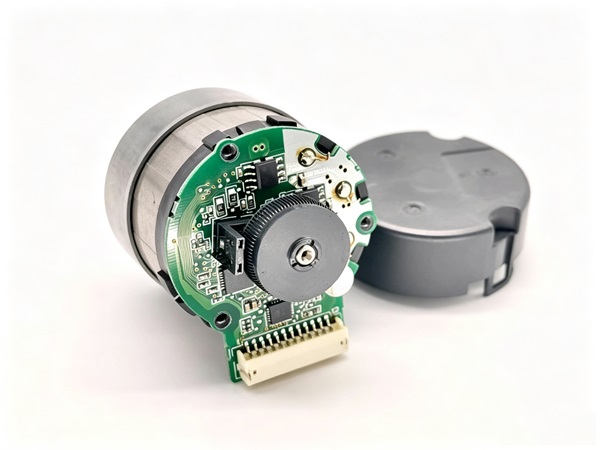
Nidec's brushless DC servo motors benefit from their scale of production and global footprint, efficient supply chain and cost control systems, and continuous technological innovation. This allows Nidec's brushless DC motors to maintain reliable performance while possessing strong price competitiveness.
The following recommended Nidec brushless DC servo motors are widely used in industries such as high-speed printers, copiers, financial equipment, medical devices, environmental protection equipment, peristaltic pumps, mixing equipment, and automation equipment:
(Author's Note: The following products are broadly defined servo motors: motor actuators capable of rapid and precise control of position, speed, or torque through a closed-loop feedback system.)
- Nidec 24H Series: Mainly includes 10W and 20W series (actual output power around 30W), equipped with 400 PPR optical encoder, positioning accuracy of ±0.9 degrees, speed range of 0~4000 rpm approximately. Motor dimensions are ∅42×34mm and ∅42×43mm.
- Nidec 48M Series: Outer rotor PLL control motor; only speed closed-loop is implemented, with speed accuracy of ±0.1%; output power within 50W; speed range of 300~3000 rpm. Considering the speed feedback signal comes from the Hall IC signals built into the motor, use is not recommended at speeds below 300 rpm.
- Nidec 24H-40W Series: Motor dimensions ∅43×43mm, actual output power within 70W, speed range of 0~5000 rpm approximately. This newly developed model by Nidec is a type of sensorless servo motor, containing no position sensors. With a positioning accuracy of around ±3 degrees, it is fully capable of handling applications requiring high motor speed but not high positioning accuracy.
For more detailed product information, please feel free to leave a message or contact us via email.