Among low-flow gas sampling devices, the 20–200 mL/min range represents the most populated segment—boasting the highest unit volume, the greatest concentration of models, and the broadest spectrum of applications.
- Adsorption tube sampling (using Tenax, activated carbon, etc.) for TVOCs, BTEX, and organic vapors: Sorbent media have strictly recommended flow rates (typically 20–200 mL/min). Excessive flow causes breakthroughor generates heat at the sorbent bed, while flow that is too low makes it impossible to accumulate an adequate sample volume within a reasonable time.
- Occupational health & personal exposure sampling (breathing zone monitoring): These units must be lightweight, person-wearable, battery-powered, and capable of running for extended periods (4–8h TWA). This necessitates compact, low-flow constant-flow pumps.
- Detector tube sampling / Long-duration cumulative sampling: The entire calibration premise of colorimetric detector tubes relies on a precise, fixed, low flow rate to ensure accurate stain-length readings.
- Sampling bypasses for compact online analyzers (NDIR / PID / Electrochemical front-ends): While the main gas line may handle higher volumes, the analyzer cell or sensor bypass specifically requires a highly stable micro-flow in the tens to 200 mL/min range.
Within this 20–200 mL/min bracket, many customers habitually default to NIDEC diaphragm air pumps. Take the NIDEC 00H220H022 as a typical example: its rated flow is >1.1 L/min. To choke this down to a target of 20–200 mL/min, the motor RPM must be drastically reduced by minimizing the PWM duty cycle.
However, driving the PWM too low severely starves the motor of drive torque (holding torque), leading to three detrimental effects:
- Significant speed ripple / fluctuation
- High susceptibility to stalling (especially as filter backpressure builds up)
- The PWM setpoint often falls into the motor's "deadband"—the below-threshold range where the motor simply cannot overcome static friction to start or maintain rotation.
Based on hands-on engineering experience, switching to the NIDEC 00H704K610 diaphragm pump effectively circumvents these issues. Originally a custom diaphragm waterpump for the ultrasonic dental scaler industry, it exhibits excellent characteristics when repurposed for gas transfer:
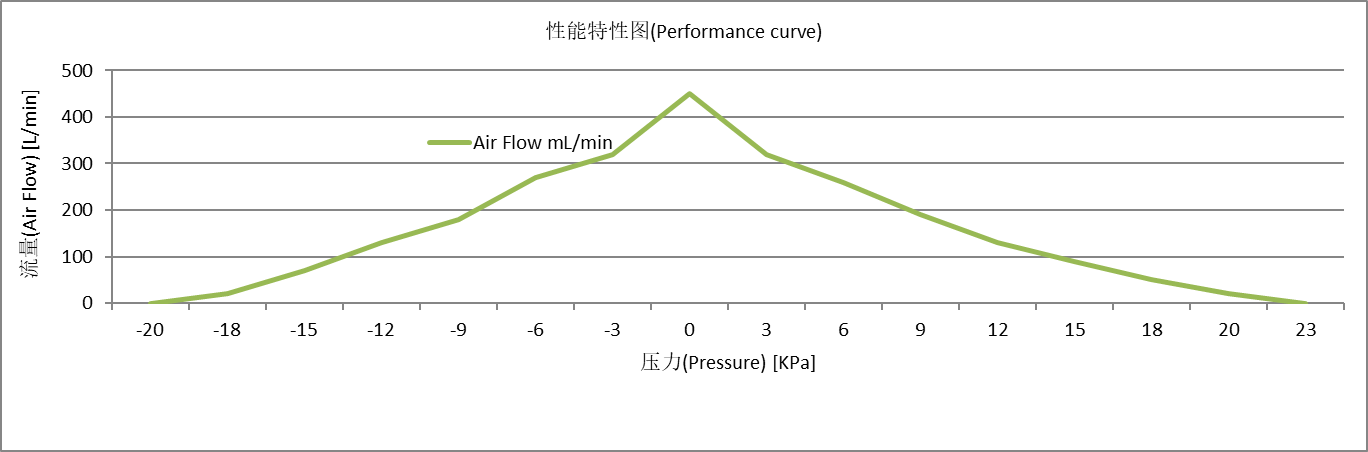
- Its natural open-flow when running gas is around 450 mL/min.
- It delivers a max vacuum of approx. -20 kPa and a max discharge pressure of 25 kPa.
- Crucially, via refined PWM control, this pump can stably lock its gas flow down to as low as 5 mL/min without hitting the deadband or stalling.
A detailed breakdown of this strategic advantage can be found in the article: "Exploring the Sources of NIDEC Diaphragm Pumps' Dominance in the Gas Detection Industry"
(Refer to the chart below for the 00H704K610 Pump Performance Curve — Pressure vs. Flow Rate (P-Q Curve), Media: Gas)