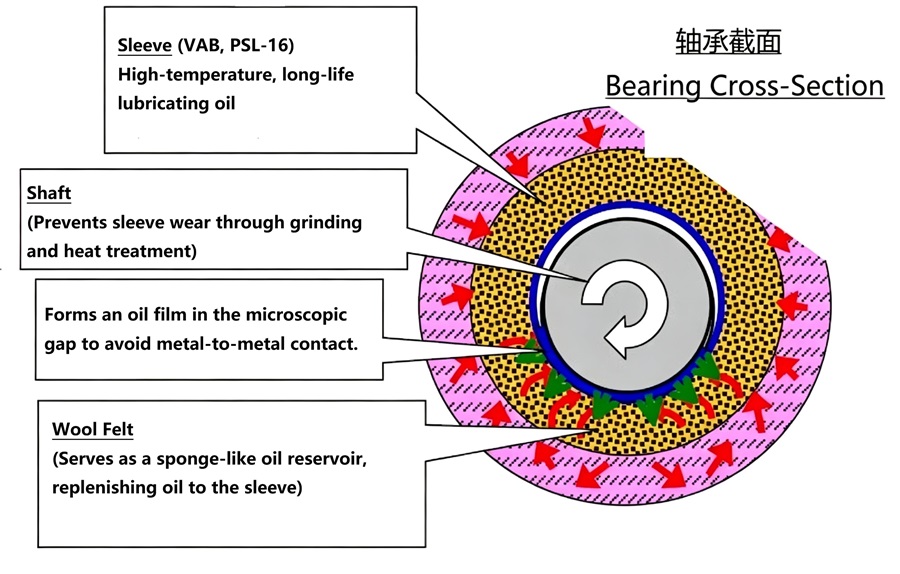
URD (Ultra Reliable Dynamic Bearing) bearings are fundamentally different from conventional oil-impregnated bearings. They are not parallel concepts within the same technical category; their core distinction lies in their lubrication and load-bearing working principles.
| Comparison Dimension | URD Bearing (Nidec Ultra Reliable Dynamic Bearing) | Conventional Oil-Impregnated Bearing (Sintered Oil-bearing) | |
|---|---|---|---|
| 1. Working Principle | Hydrodynamic bearing. During shaft rotation, a high-pressure oil film forms in the wedge-shaped gap between the shaft and the bearing sleeve, completely lifting the shaft to achieve full fluid-film lubrication with no direct metal-to-metal contact. | Boundary lubrication / Capillary action lubrication. Relies on the porous characteristics of sintered metal material to store lubricating oil, which seeps to the friction surface via capillary action. At low speeds or during start-up, it operates in a boundary or mixed lubrication state, where metal contact exists. | |
| 2. Core Structure | Precise structure containing dedicated oil passages, oil grooves, an oil tank (reservoir), and taper surfaces to actively establish, maintain, and seal the oil film. This is a proprietary structural design for achieving long life. | Simple structure, typically a single-material sintered sleeve. Relies on the material's own pores to store oil, with no complex active oil passage design. | |
| 3. Performance | • Extremely Quiet: Oil film damping effectively eliminates mechanical contact noise.• Ultra-Long Life: Life is determined by a predictable lubricant consumption model, reaching tens of thousands of hours.• High-Speed & High-Temp: Optimized for continuous operation at high speeds (>7200 rpm) and high temperatures (85°C+). | • Higher Noise: Exists boundary friction noise at low speeds.• Limited Life: Life depends on the consumption and replenishment capability of oil within the pores, making it difficult to maintain long-term under high-temperature, high-speed conditions.• Low/Medium Speed & Load: Suitable for medium-to-low speed, intermittent operation, and low-to-medium load applications. | |
| 4. Failure Mode | Primary failure mode is the depletion of lubricating oil after long-term evaporation and leakage, leading to oil film breakdown (life endpoint defined as oil content <10%). This is a predictable, gradual process. | Failure modes include lubricant coking, pore blockage, early wear or seizure due to insufficient oil supply, and lubricant failure from "oil slinging" at high speeds. Failure is more random. | |
| 5. Cost & Application | High cost, high technical content. Used in scenarios demanding ultimate reliability, quietness, and lifespan, such as projector color wheel motors, laser scanning equipment, etc. | Low cost, highly versatile. Widely used in household appliances, small motors, low-power transmission mechanisms, and other cost-sensitive products. |
Summary:
The URD bearing is a high-performance, active liquid bearing system based on the hydrodynamic principle, and in essence, belongs to the FDB (Fluid Dynamic Bearing) family. In contrast, the conventional oil-impregnated bearing is a passive sliding bearing based on pore oil storage and capillary action. The former "actively generates" a stable load-bearing oil film through precise engineering design to achieve contact-free operation; the latter relies on material properties to "passively exude" lubricating oil, making it difficult to completely avoid frictional contact.
Below is a cross-sectional illustration of the URD bearing: