Editor's Note:
In product design, the quality of the motor solution often directly determines how easily the product can be realized, its final performance, and overall cost. An ideal motor must not only meet technical requirements for control accuracy, response speed, and efficiency, but also balance compactness, reliability, and cost-effectiveness in its structure. Through this article, the editor hopes to help engineers and product developers gain a deeper understanding of this new-generation compact positioning control brushless DC motor across different real-world applications — and embrace it. With unique advantages such as sensorless position control, integrated board-in-motor design, and quiet wide-speed-range operation, it is becoming an ideal alternative to traditional stepper motors and servo systems, helping your product achieve the perfect balance between miniaturization, low noise, and high cost-performance.
Applicable Scenarios:
- Fans, water pumps, etc.: Not demanding on instant start/stop or fast response (high dynamic performance), but require high steady-state speed accuracy. The main challenge here is solving speed fluctuation caused by load variation.
- Conveyor belts, simple material handling: Require stable speed control, with position accuracy generally at medium to low levels. Using expensive servo motors in such cases would be wasteful.
- Mixing equipment: Need stable speed control from low speed (a few to tens of rpm) all the way to high speed (up to 5000 rpm). The key issue solved is insufficient low-speed torque.
- Peristaltic pumps, syringe pumps, metering pumps, etc.: Demand high integration, small motor size, high efficiency, and low heat generation. This motor offers both low- and high-speed controllability, with an all-in-one design that requires no extra drive circuit. As a BLDC motor, it delivers high efficiency and low heat — clear advantages.
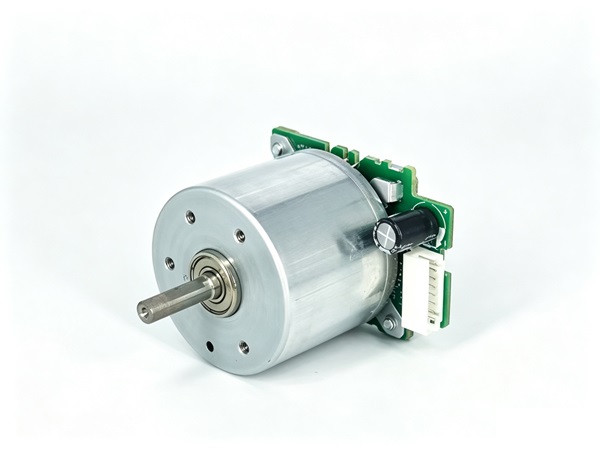
NIDEC 70W Sensorless Position Control Motor (SP Series)
I. Disruptive Technology: Sensorless Position Control
- Core Principle: Without relying on Hall elements, encoders, or reluctance sensors, rotor position is accurately estimated by detecting internal electrical characteristics of the motor.
- Control Method: Receives pulse signals for position control like a stepper motor, but possesses the closed-loop characteristics of a servo — faster and smoother dynamic response.
- Control Accuracy: 1 pulse = 0.9°,Achieves positioning accuracy equivalent to HB stepper motors, while avoiding stepper issues such as step loss and resonance.
- Summary: The easy control of a stepper, with the stability and reliability of a servo.
II. Extreme Integration: Board-in-Motor Design
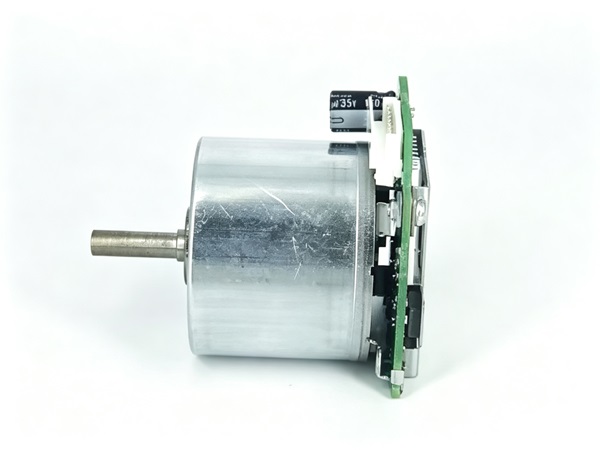
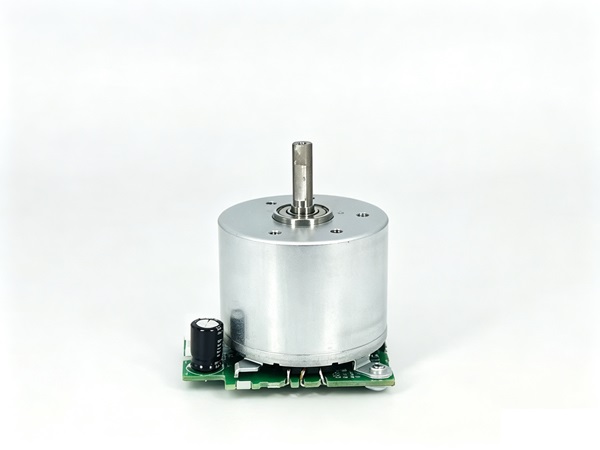
- High Integration: Motor body and drive circuit are combined into one — no external driver, terminal block, or extra controller needed.
- Size Advantage: Overall dimensions only Φ43 × 43.4 mm, yet delivering 70W of power — industry-leading miniaturization in its class.
- Lightweight: Significantly reduces part count, helping end devices lose weight and shrink in size. Ideal for space- and weight-critical scenarios (e.g., collaborative robots, medical handheld devices, precision instruments).
- Summary: Plug and play — no more driver wiring hassle.
III. Excellent Performance Parameters
| Item | Parameter / Performance |
|---|---|
| Rated Power | 70W |
| Dimensions | Φ43 × 43.4 mm |
| Supply Voltage | DC 24V |
| Speed Range | 0 ~ 5000 rpm (wide range) |
| Torque Characteristic | Stable torque output from 0~5000 rpm (see torque curve) |
| Motor Efficiency | Maintains high efficiency in 1000~4000 rpm range; overall better than同级 steppers |
| Continuous Duty Zone | Continuous adiabatic duty region reference curve provided for thermal design and life evaluation |
IV. The Quiet Revolution: Eliminating Stepper's Harsh Noise
- Pain Point Solved: Traditional steppers generate sharp high-frequency noise at low speed (usually from electromagnetic resonance).
- Innovative Solution: Carrier frequency of detection pulses raised from conventional 15kHz to 18kHz.
- Effect: 18kHz exceeds the human hearing upper limit (~20kHz; most adults actually hear below 16kHz), so the noise is completely inaudible — truly quiet operation.
- Note: Pulse peaks still exist at low speed for position detection, but shifting the frequency moves noise energy out of the audible range, significantly improving user experience.
- Summary: Let your device breathe in silence.
V. Recommended Typical Applications
| Industry | Application Examples | Why Choose SP Series |
|---|---|---|
| Automation Assembly | Small transfer modules, grippers | Sensorless + integrated design saves space & wiring cost |
| Medical Devices | Infusion pumps, surgical micro-stage | Low noise, high reliability, easy to clean in sterile environments |
| Office Equipment | Printers, scanners, copiers | Compact, quiet, long-life |
| Robotics | Light collaborative robot joints | Medium precision, no step loss, pulse control compatible with existing systems |
| Lab Instruments | Micro-pumps, centrifugal mixers, auto-samplers | Precise positioning, low vibration, maintenance-free |
VI. Why Ditch Traditional Steppers for the SP Series?
| Comparison | Traditional Stepper | NIDEC SP Series |
|---|---|---|
| Sensors | Needs encoder or Hall (adds cost & size) | Sensorless — position estimated by algorithm |
| Driver | External driver required | Built-in board, plug-and-play |
| Noise | Harsh audible noise at low speed | Inaudible to human ear (18kHz carrier) |
| Size | Motor + driver take significant space | All-in-one, Φ43×43.4mm |
| Control Accuracy | Open-loop, prone to step loss | Closed-loop equivalent, same accuracy as stepper |
| Dynamic Response | Slow, with low-frequency oscillation | Fast & smooth, no resonance |
VII. Conclusion
The NIDEC SP Series sensorless position control motor is not a simple "stepper replacement" — it is a brand-new category that fuses the ease of use of steppers, the high performance of servos, and the low cost & high reliability of sensorless design. It is built for modern industrial and consumer electronics that demand miniaturization, quietness, and integration.
If you're looking for a motor that:
✅ Needs no extra driver
✅ Generates no harsh noise
✅ Delivers a wide speed range with stable low-speed torque
✅ Runs faster than a stepper, costs less than a servo
✅ Fits in tight spaces and outputs up to 70W — with positioning capability
Then this is the answer.