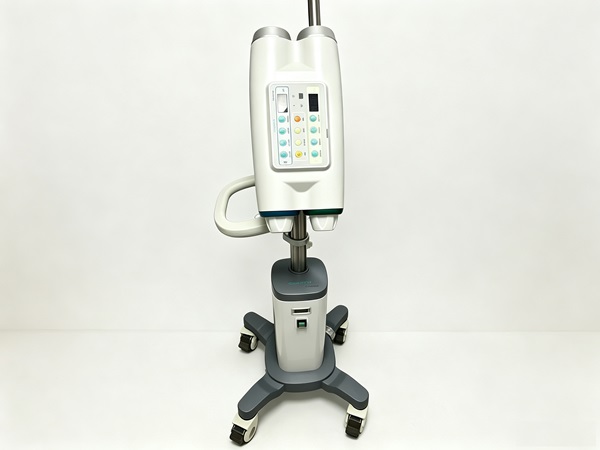
Technical Requirements for Dual-Syringe CT High-Pressure Injector
A CT high-pressure injector is used to rapidly inject iodinated contrast media during enhanced scanning. Its core actuation mechanism is a motor driving a lead screw (or via a reduction mechanism) to push the piston. Based on general industry standards and actual device operating conditions, the technical requirements are summarized as follows:
1. Thrust and Pressure Requirements
- Injection pressure: single-syringe working pressure range 50–350 psi (approx. 0.34–2.4 MPa), corresponding to piston thrust of approx. 600–4500 N (estimated using a 200 mL syringe with inner diameter ≈ 50 mm)
- Peak pressure protection: the system shall provide automatic speed reduction / shutdown on overpressure, with a configurable pressure limit
2. Flow Rate and Volume Requirements
- Flow rate range: 0.1–10.0 mL/s, step 0.1 mL/s
- Multi-phase injection: support ≥ 5 flow-rate segments (e.g., contrast → line flush → saline)
- Injection volume: single syringe 50 / 100 / 150 / 200 mL, dual syringes independently controlled
- Flow accuracy: ≤ ±1% (±0.5% for high-end devices)
3. Motion Control and Positioning Accuracy
- Position control: controlled by pulse (CLK) signals, similar to open-loop positioning of a stepper motor
- Start/stop response: full flow established within 0.2–0.5 s acceleration time; smooth deceleration
- Synchronization: support synchronization with CT scan trigger signals (DICOM / X-ray gating), adjustable delay 0–600 s
4. Electrical and Environmental
- Power supply: DC 24 V (via system switch-mode power supply or battery)
- Noise: operating noise ≤ 50 dB(A); no harsh electromagnetic sound at low speed
- Continuous operation: capable of consecutive multi-patient, multi-phase injections (thermally continuous operation)
- Safety: air-bubble detection, line occlusion protection, extravasation protection, emergency stop
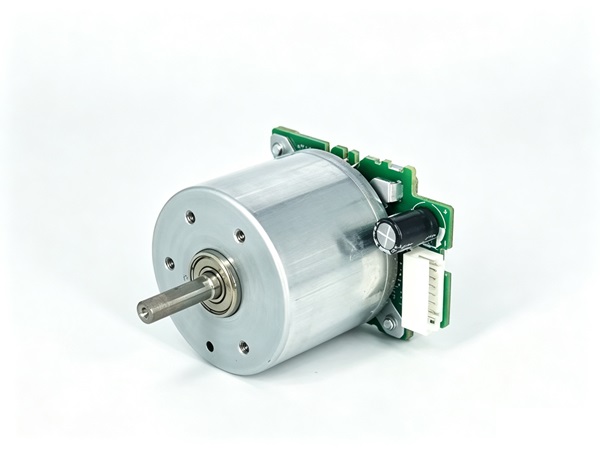
Adaptation Advantages of the 24H Sensorless Positionable Brushless DC Motor (SP43-40)
The Nidec 24H series (SP43-40, rated 40 W, measured output up to approx. 70 W) is an inner-rotor brushless motor with an integrated control circuit and motor body. It adopts sensorless positionable control technology: by simply inputting pulse signals, it can achieve stepper-motor-like position/speed control without an external driver board. Its advantages in CT high-pressure injectors (especially dual-channel models) are as follows:
1. Small Size and Light Weight — Significantly Reduce Overall Device Dimensions
| Item | Traditional 57 mm HB Stepper Motor | SP43-40 Sensorless Positionable Brushless |
|---|---|---|
| Cross-section | 57 × 57 mm | 42 × 42 mm (direct replacement) |
| External driver board | Required | Not required (built-in control circuit) |
| Weight | Heavier | Much lighter at equivalent output |
The traditional solution requires motor + external driver board + heat dissipation space. The SP43-40 integrates the control circuit into the motor body, enabling direct replacement of a 57 mm HB stepper motor in a smaller footprint and eliminating the external driver board. For dual-channel CT high-pressure injectors, the two injection heads are arranged side by side, and the head width is often limited by motor size — adopting the SP43-40 significantly shrinks the head volume, making the device more compact and easier to move and position in narrow CT rooms.
2. High Power Density — Meets Thrust Requirements After Reduction
- Rated 40 W, measured output up to approx. 70 W (user-measured data)
- Rated torque 240 mNm, rated speed 3000 min⁻¹
- A reduction gearbox can increase the output torque to the level required by the load, fully covering the thrust needed for CT injection pistons
- Speed range 0–5000 rpm; with lead screw and gearbox, it covers 0.1–10 mL/s and even higher flow rates
3. Excellent Efficiency — Longer Battery Runtime
- Efficiency under rated load is better than that of equivalent HB stepper motors (stepper efficiency is typically only 30–50%, while the brushless solution can reach 70–80% or more)
- For mobile CT high-pressure injectors or battery backup (UPS) scenarios, high efficiency means significantly fewer recharges
4. Noticeably Improved Noise and Vibration
- HB stepper motors exhibit obvious cogging-torque noise and high-frequency electromagnetic sound at low speed
- The SP43-40 uses sensorless control; the low-speed position-detection electromagnetic tone varies at 15–18 kHz, which is outside the human audible range, so the perceived noise is essentially eliminated
- In the relatively quiet environment of a CT room, low noise improves patient comfort and the operator experience
5. Good Control Compatibility — Easy Solution Migration
- Like an HB stepper motor, it is controlled by input CLK pulse signals, so the control interface is compatible
- Existing stepper-based control boards require only minor software changes; hardware only needs motor-side replacement
- Supports S-curve acceleration/deceleration commands, reducing inertia shock and making piston start/stop smoother
6. Accuracy Characteristics to Note (Selection Advice)
According to the datasheet comparison, the SP43-40 differs from HB stepper motors in the following aspects and should be evaluated against the actual operating conditions:
| Characteristic | HB Stepper Motor | SP43-40 | Impact on CT Injection |
|---|---|---|---|
| Rotation accuracy | Excellent | Excellent | — |
| Position error | Very small | ±3° at stop / constant speed | With lead screw and reduction ratio, position error is negligible |
| Step-loss risk | Low | None | — |
Accuracy check example: with a 15:1 reduction ratio and a 5 mm lead screw pitch, a motor position error of ±3° corresponds to a piston displacement of only about ±0.625 μm, far smaller than the 0.1 mL (≈20 μL) dose step — steady-state accuracy is more than sufficient. For the CT high-pressure injection flow accuracy requirement of ±1%, this motor solution is accurate enough.
SP43-40 Motor Technical Parameters
Core parameters compiled from the motor documentation:
| Item | Specification |
|---|---|
| Product family | 24H inner-rotor sensorless positionable brushless motor (SP series) |
| Representative model | SP43-40 (40 W class, actual power up to approx. 70 W) |
| Dimensions | 42 × 42 mm cross-section (same footprint as 42 mm HB stepper motor) |
| Rated voltage | DC 24 V |
| Rated output | 40 W (nominal), actual approx. 70 W |
| Rated torque | 240 mNm @ 3000 rpm |
| Speed range | 0–5000 rpm |
| Control method | Sensorless positionable control, CLK pulse signal input (stepper-motor-like) |
| Control circuit | Built-in (motor + control circuit integrated, no external driver board) |
| Efficiency | Better than equivalent HB stepper motor under rated load (see torque-efficiency curve) |
| Noise characteristic | Low-speed electromagnetic tone 15–18 kHz (outside human hearing); perceived noise eliminated |
| Weight | 260 g (much lighter than HB stepper at equivalent output) |
| Position error | ±3° at stop / constant speed |
| Replaceability | Can replace 42 mm HB stepper in same space; same electrical characteristics can replace 57 mm and 86 mm HB steppers |
Application note: For dual-syringe CT high-pressure injectors, piston advancement is achieved by configuring a planetary gearbox and ball screw. The dual-syringe system requires 2 motors in total, and the total installation space can be reduced by approx. 30–40% compared with the traditional stepper solution.
Summary: With its 42 mm body, built-in driver, ~70 W output, high efficiency, and low noise, the Nidec 24H SP43-40 — when matched with a reduction gearbox and lead screw — well satisfies the thrust, speed, accuracy, and size requirements of CT high-pressure injectors. It is especially suitable for new-product development of dual-channel compact CT high-pressure injectors and for retrofitting conventional equipment.