
Significant improvement in noise and vibration after switching the motor drive from traditional 120° square wave commutation to 180° sine wave commutation:
Technical Improvement Background
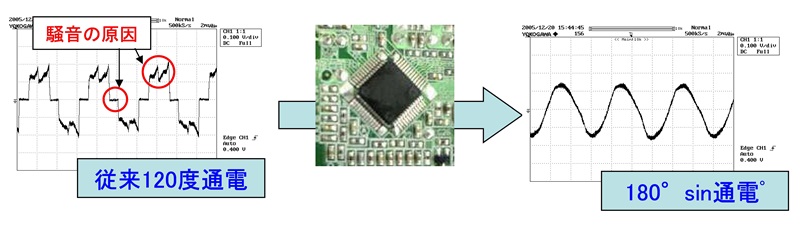
Improvement logic: There are limits to optimization through magnetic and mechanical structures alone, so the approach shifted to using IC-based commutation methods (fundamentally improving the current waveform), i.e., utilizing the software/hardware algorithms of the control chip (IC) to optimize the drive current.
Fundamental Improvement of Current Waveform
Traditional 120° commutation (left):
180° sine wave commutation (right):
Striking Comparison of Noise Data
The lower part of the figure provides an intuitive comparison of noise levels between the conventional scheme and the new scheme via noise spectrum test charts:
Conventional IC (left):
Silent IC (right):
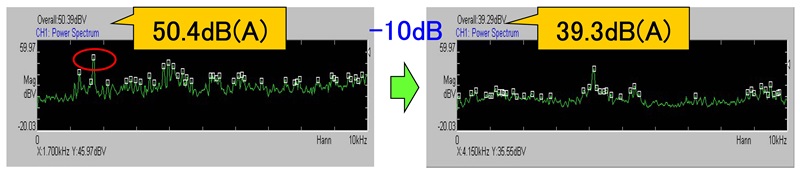
Noise reduction effect: a difference of –10 dB (decibel is a logarithmic unit; a reduction of 10 dB means the subjective loudness perceived by the human ear is roughly halved).
Summary of Technical Principles
Square wave drive (120° commutation): Typically two phases are energized while one phase is floating, resulting in a rectangular current waveform. Because the current waveform does not match the motor’s back EMF, large commutation torque ripple occurs, causing harsh motor operation, high vibration, and loud noise (often accompanied by electromagnetic “humming”).
Sine wave drive (180° commutation): All three phases are energized simultaneously, and the current changes smoothly as a sine wave. This allows the stator magnetic field to attract the rotor smoothly, producing constant torque and significantly reducing torque ripple. Although the controller’s high-frequency PWM modulation introduces a small increase in switching losses, the current on the motor side is clean, iron losses are extremely low, and the motor runs exceptionally smoothly and quietly.
Conclusion: The experiment fully demonstrates that by adopting a silent IC with 180° sine wave commutation to replace the traditional 120° square wave commutation method, motor noise has been successfully reduced by approximately 10 dB, achieving a remarkable noise suppression effect.