
The Carbon-13 urea breath test is a non-invasive, first-choice method for detecting Helicobacter pyloriinfection. It is recognized by both domestic and international guidelines as the "non-invasive gold standard" for Hp detection. The test is painless, offers high accuracy (over 95%), and is especially suitable for children, the elderly, and individuals with sensitive gastrointestinal systems. It works by detecting urease produced by Helicobacter pylorito determine the presence of infection.
Carbon-13 breath analyzer models equipped with auto-sampling, online continuous sampling, and internal gas path delivery utilize a diaphragm pump. The operational workflow is as follows:
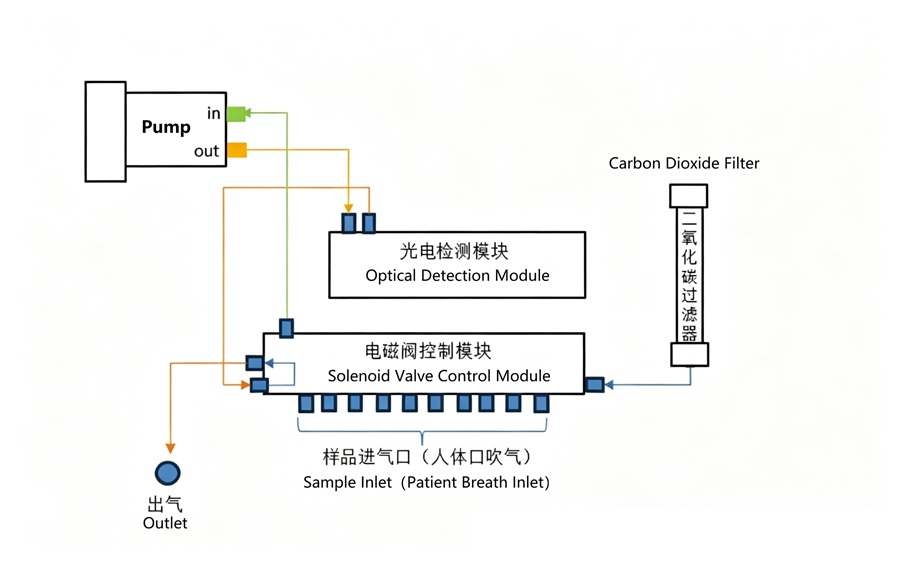
When used as a gas sampling pump, the diaphragm pump's essential requirements are: clean, controllable, verifiable, non-contaminating to the sample, non-interfering with the detection signal, and preventing cross-contamination to the next patient.
Air Tightness / Zero Cross-Contamination: The pump chamber, valve seat, and diaphragm materials must not adsorb or release volatile organic compounds. Internal flow channels should have no dead zones or be easy to clean, with extremely low external leakage rates.
Flow Accuracy and Stability directly affect DOB (delta over baseline) accuracy. Typical gas path operating points are in the range of 0.5–2.0 L/min. The critical requirement is stable flow with minimal fluctuation.
Priority consideration should be given to supporting PWM/voltage speed control and enabling closed-loop flow control.
Moisture Resistance, Condensation Prevention, and Sample Humidity Handling: Exhaled breath is a saturated humid gas (≈37°C, nearly 100% RH), which can condense when entering room-temperature tubing. The pump material itself must withstand brief exposure to moisture and微量 water ingestion. The diaphragm and valve materials must not swell, harden, or age when exposed to trace moisture (common choices: EPDM, silicone, or PTFE composites).
Low Pulsation and Low Vibration are required to protect optical detection. When the pump outlet is connected directly in series near the infrared detection cavity, the reciprocating pulsation of the diaphragm pump introduces flow fluctuations, which cause CO₂ concentration variations and consequently degrade measurement precision.
As a medical device, low EMI (electromagnetic interference) is required.
For hospital and clinic environments, the pump must be quiet.
Based on the hospital usage characteristics of high-frequency, intermittent operation for Carbon-13 breath analyzers, the design life of the diaphragm pump should exceed 3,000 hours.
Currently, the main NIDEC diaphragm pump models applied in Carbon-13 breath analyzers are: 00H220H022 and 00H220H042.
For product documentation on the above models, please leave a message or contact us via email.