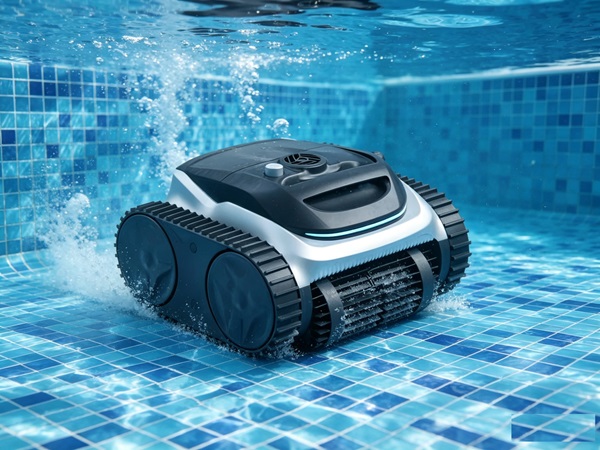
Taking Pool Cleaning Robots from “Single-Function” to an All-in-One Form Factor
The Status Quo: Most current surface skimmer robots (including many models on the market) stay afloat using four fixed foam floats that lock the chassis at a fixed height above the waterline.
Advantages: simple structure, low cost, high reliability, and almost nothing to go wrong mechanically.
Disadvantages: the draft (how deep the intake sits) cannot adapt to wave action, water-level changes, or increasing debris load. The system is inherently single-purpose—it cannot submerge, so it can never clean the pool floor or walls. On top of that, wave resistance is limited, which directly hurts collection efficiency whenever the surface gets choppy.
The Diaphragm-Pump Solution: From “Specialist” to “All-In-One Machine”
The alternative approach uses a diaphragm pump to inflate/deflate an air bladder, actively controlling the robot’s buoyancy and trim (attitude), so the vessel can dial inits draft instead of being locked into one.
Coupled with a water-ballast tank (fill/drain) for fine weight control, the platform gains submerged capability, enabling true surface ↔ dive mode switching—all driven by one pneumatic loop + one hydraulic loop, sharing controller and power.
What This Architecture Actually Delivers
1) One machine replaces two — lower total cost of ownership
In the traditional setup, full-pool coverage means buying both a surface skimmer anda floor/wall cleaner: double CAPEX, double storage footprint, double maintenance.
With the diaphragm-pump architecture, surface + floor/wall capability lives in one platform, so the user pays once, stores one unit, manages one schedule, and gets whole-pool coverage.
2) Dynamic draft control that adapts to real conditions
The fixed-float flaw is simple: as the debris basket fills and weight grows, the hull doesn’t compensate, so intake positioning drifts and performance degrades (too shallow when empty → poor pickup; too deep when full → water ingress risk).
With an air-bladder + pressure feedback, the robot can:
- Lightly deflate when the basket is empty → sit slightly deeper so the skimmer mouth tracks the surface better
- Progressively inflate as load increases → hold the target draft steady despite added weight
- Boost pressure in chop/wind → lift the hull a touch and reduce wave slap / splash ingress
Result: the machine stays in its optimal operating window regardless of load or surface conditions.
3) Surface / Dive dual-mode switching = genuine whole-pool coverage
Fixed floats can’t dive—period.
With bladder + ballast, you get repeatable modes:
- Surface Mode: bladder inflated (positive buoyancy), ballast drained → stable skimming of leaves, insects, surface oils
- Dive Mode: bladder relaxed/deflated, ballast filled → negative buoyancy → smooth descent for floor sediment & wall algae
- Transition: controlled bladder change + ballast exchange for clean, hands-off surfacing/submerging transitions
That’s not “better skimming.” That’s full-pool capability in one chassis.
4) Stronger wave resilience for outdoor pools
Wind and surface chop break fixed-float platforms: wobble kills tracking, the intake wanders, and collection efficiency collapses—sometimes ending in a flip.
An active bladder system can shift its center of buoyancy and trim on purpose:
- Raise the hull in rougher conditions to reduce projected area to waves
- Even operate semi-submerged, keeping only the skimmer mouth at the surface while the body rides lower and calmer
Stability improves, downtime drops, and the unit keeps working instead of needing rescue.
5) A “live” platform ready for smart upgrades
Fixed flotation is a dead variable—it can’t be commanded. Bladder control is a controllable state, which means it can be paired with sensors/logic:
- Basket-full detection via bladder pressure behavior
- Adaptive wave compensation via IMU/attitude sensing
- Auto-surface + dock using buoyancy as the actuator, not just propulsion
- App-driven preferences (prioritize surface vs. floor, adjust draft aggressiveness, etc.)
This turns the robot from a “set-and-forget appliance” into a software-upgradable platform.
Representative Nidec Diaphragm Pump Models Used in Pool-Cleaner Applications
- 00H220H022
- 00H220H042